
China Top 10 Digital Print Socks Manufacturers
China’s Digital Print Socks industry is moving from basic decoration toward precise, on-demand textile manufacturing. Vibrant graphics now appear on ribbed cuffs, athletic heels, and seamless toe areas. These details test registration accuracy, ink adhesion, color consistency, and production discipline.
Grand View Research estimates the global digital textile printing market reached about USD 4.9 billion in 2023. Its report projects a 12.1% compound annual growth rate from 2024 to 2030. Smithers’ market analysis also identifies digital textile printing as a continuing growth area through 2028. However, these reports cover broader textile applications, not socks alone. That limitation matters.
Debbie McKeegan, founder of Texintel and a recognized digital textile printing specialist, said, “Digital textile printing is a process of continuous innovation.” Her observation fits China’s manufacturing landscape. Leading factories combine rotary knitting, reactive or pigment printing, automated inspection, and flexible minimum-order services. Some also support recycled yarns and certified materials.
This “China Top 10 Digital Print Socks Manufacturers” guide evaluates suppliers through practical criteria. These include equipment capability, sample quality, color management, customization depth, export experience, certifications, and delivery reliability. Factory visits and sample comparisons remain valuable. Online claims can look polished.
No ranking is perfectly neutral. Product quality can change between batches, seasons, and production teams. Buyers should request physical samples, wash-test results, laboratory certificates, and clear packaging specifications. A beautiful catalog is not enough. The strongest manufacturers are not merely inexpensive. They are measurable, responsive, and transparent when production problems appear.
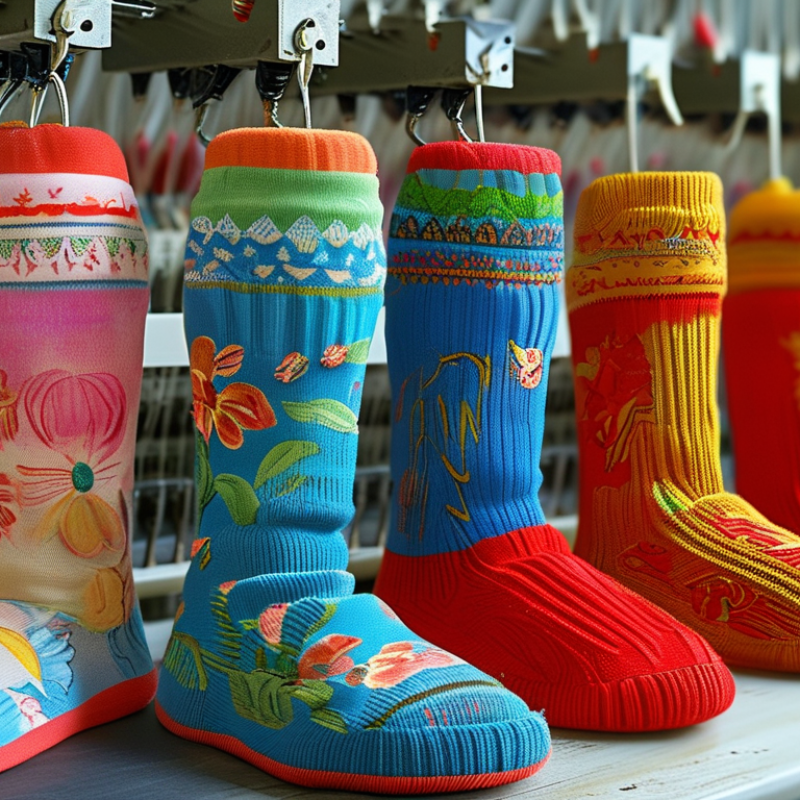
Meaning and Scope of Digital Print Sock Manufacturing in China
Digital print sock manufacturing in China covers more than applying colorful images to finished socks. It includes artwork preparation, circular knitting, fabric treatment, digital printing, steaming or heat setting, sewing, inspection, and packaging. The production route depends on fiber content. Polyester socks often use sublimation printing, while cotton-rich socks may require reactive or pigment systems. The boundary is not perfectly clean.
Textile Exchange’s 2024 Materials Market Report recorded global fiber production at 124 million tonnes in 2023. Polyester represented about 57% of that volume, supporting strong demand for synthetic sports and fashion socks. Smithers’ report, The Future of Digital Textile Printing to 2027, also identifies shorter runs, faster sampling, and reduced setup waste as important advantages of digital textile production. These factors explain why Chinese manufacturers increasingly serve customized orders, seasonal collections, and small online releases.
A serious supplier should show more than attractive samples. Buyers need color-management records, wash-fastness results, shrinkage data, and production photographs. A factory visit can reveal whether printing, curing, and inspection occur under controlled conditions. I have found that sample approval is often weaker than production approval. Colors may shift on ribbed surfaces, and fine graphics can lose clarity after stretching. Therefore, evaluating the top ten manufacturers requires practical evidence: repeatability, material knowledge, documented testing, and honest communication about technical limits.
How to Evaluate China’s Top Digital Print Sock Manufacturers
Evaluating China’s top digital print sock manufacturers requires more than comparing quotations. Check whether the factory controls artwork, knitting, printing, curing, and packing in-house. Ask for production records, not only showroom samples. A reliable supplier should provide color-control procedures, wash-test results, stretch recovery data, and inspection reports for each batch. Request a pre-production sample with your actual artwork. Small details matter.
Textile Exchange’s 2024 Materials Market Report estimates global fiber production reached 124 million tonnes in 2023, while polyester represented about 57%. This makes fiber traceability important when selecting printed socks. Confirm yarn composition, recycled content claims, and supporting transaction documents. For performance testing, compare results against recognized AATCC or ISO methods, especially for colorfastness, abrasion, and dimensional change. A bright sample may still fail after repeated washing.
Production capacity also needs evidence. Review machine lists, daily output, minimum order quantities, and peak-season lead times. Ask how rejected socks are separated and recorded. Digital printing can reduce setup waste for smaller runs, but unit costs may rise with complex artwork or dark bases. Industry forecasts from Smithers identify continued growth in digital textile printing, yet growth does not guarantee consistent factory execution. A cheaper offer can become expensive through rework. I would score suppliers by verified quality, traceability, communication, and corrective action—not price alone. Mistakes still happen; the real test is how clearly the manufacturer responds.
China Top 10 Digital Print Socks Manufacturers - How to Evaluate China’s Top Digital Print Sock Manufacturers
| No. | Evaluation Dimension | What to Evaluate | Reliable Evidence to Request | Practical Selection Benchmark | Suggested Weight |
|---|---|---|---|---|---|
| 1 | Digital Printing Capability | Confirm whether the factory operates direct-to-garment or other digital sock-printing equipment suitable for the required fiber composition, sock size, and artwork complexity. | Current equipment list, production photographs or videos, sample prints, and a description of compatible fibers. | The supplier should demonstrate repeatable results on the actual sock construction and material required for the order. | 15% |
| 2 | Color Management | Assess color-matching controls, artwork preparation, calibration procedures, and the ability to maintain consistency between approved samples and bulk production. | Color approval workflow, printed strike-offs, color measurement records, and written tolerance criteria. | A pre-production sample should be approved before bulk manufacturing, with an agreed color tolerance and inspection method. | 12% |
| 3 | Ink Safety and Chemical Compliance | Check whether inks, dyes, auxiliaries, and finished socks meet the chemical requirements of the intended sales market. | Recent third-party laboratory reports, chemical declarations, safety data sheets, and applicable compliance documentation. | For European sales, request evidence related to REACH requirements; for the United States, verify applicable consumer-product and children’s-product requirements. | 13% |
| 4 | Fabric and Fiber Compatibility | Review the fiber content, yarn quality, fabric weight, elasticity, surface texture, and how these factors affect print clarity and durability. | Material specifications, yarn certificates, fabric test reports, and samples made with the proposed composition. | The supplier should clearly identify composition and construction and should not substitute materials without written approval. | 10% |
| 5 | Print Durability and Product Quality | Evaluate wash resistance, rubbing resistance, stretch recovery, dimensional stability, seam strength, and overall comfort. | Independent wash and abrasion test reports, internal inspection records, and samples tested under the buyer’s care instructions. | Approval should be based on test results from the final sock, not only on loose fabric or a digitally printed paper sample. | 15% |
| 6 | Quality Management System | Determine whether the factory controls incoming materials, artwork approval, in-process production, final inspection, corrective actions, and traceability. | Quality manual, inspection checklist, corrective-action records, audit reports, and certification details where applicable. | A documented inspection process and traceable batch records should be available for every production order. | 10% |
| 7 | Sampling and Artwork Service | Assess technical support for file preparation, repeat sampling, size grading, pattern placement, and approval management. | Artwork specification template, sampling procedure, revision records, and examples of approved technical files. | The factory should provide a physical pre-production sample and obtain written approval before starting bulk production. | 8% |
| 8 | Capacity, MOQ, and Lead Time | Compare minimum order quantity, sample turnaround, bulk production schedule, peak-season capacity, and the supplier’s ability to handle repeat orders. | Written quotation, production calendar, capacity statement, and references for comparable order volumes. | Choose a supplier whose confirmed MOQ and lead time match the project instead of relying on an unverified standard promise. | 7% |
| 9 | Export and Packaging Capability | Review export documentation, carton standards, labeling support, packaging customization, and experience with the destination market. | Commercial invoice template, packing list, carton details, labeling examples, and agreed Incoterms. | Packaging and labeling requirements should be confirmed in writing before production and checked during final inspection. | 5% |
| 10 | Communication and Commercial Reliability | Evaluate response speed, technical accuracy, transparency about subcontracting, payment terms, warranty policy, and handling of quality claims. | Signed quotation, production agreement, response records, quality-claim procedure, and clearly identified manufacturing locations. | Prefer suppliers that provide complete written answers, realistic schedules, transparent terms, and a defined remedy for nonconforming goods. | 5% |
Note: The benchmarks above are buyer-side evaluation criteria rather than claims about any individual supplier. Certification and test documents should be checked for scope, validity, issuing laboratory, and the exact product covered.
Top 10 Digital Print Sock Manufacturers in China
China’s digital print sock sector is developing alongside wider textile technology. Grand View Research estimated the global digital textile printing market at approximately US$2.7 billion in 2023. Its forecast also indicates annual growth above 12% through 2030. This demand is visible in sample rooms, where designers test sharp logos, gradient artwork, and full-foot patterns on polyester, cotton, and blended yarns.
A reliable Top 10 list should examine more than factory size. Production experience matters, especially with heel alignment, toe closure, and color consistency. Manufacturers should provide documented ink standards, fabric testing, and batch inspection records. The Sustainable Apparel Coalition’s Higg materials guidance also highlights energy, water, and chemical management as important supply-chain factors. Ask for recent test reports. Photographs are not enough.
Practical buyers should compare minimum order quantities, sampling speed, knitting capacity, and packaging control. A strong supplier can explain how artwork changes after stretching over the foot. That detail is often missed. Digital printing may reduce plate preparation and support shorter design runs, but waste can still appear during setup and failed color matching. Smithers’ textile printing research identifies personalization and shorter production cycles as major growth drivers. Still, supplier claims require verification. Request a physical sample, wash-test results, fiber composition, and a production timeline before ranking any manufacturer. Mistakes happen. Good records make them visible.
China Top 10 Digital Print Socks Manufacturers
This chart presents a neutral evaluation framework for comparing leading digital print sock manufacturers in China. The percentages represent the recommended importance of each purchasing criterion rather than company-specific or brand-specific data.
Evaluation dimensions: print quality, customization, material range, MOQ flexibility, lead time, compliance, and export experience.
Production Technologies, Materials, and Customization Options
China Top 10 Digital Print Socks Manufacturers
When assessing China’s top ten digital print sock manufacturers, production technology deserves close attention. Modern factories commonly use inkjet systems with computer-controlled color separation and rotary positioning. These processes reduce setup time for small orders and detailed patterns. The 2023 Grand View Research report valued the global digital textile printing market at approximately USD 4.9 billion. This growth reflects demand for short runs, fast sampling, and personalized designs. However, machine age still affects color consistency and output speed.
Materials shape both comfort and print performance. The 2024 Textile Exchange Materials Market Report stated that polyester represented about 59% of global fiber production in 2023. Polyester socks usually provide sharper sublimation results and stronger color retention. Cotton offers a softer hand feel, but it may require pigment or reactive printing. Blended yarns can balance stretch, breathability, and durability. Testing matters more than promises.
Customization may include jacquard-like visual effects, full-surface graphics, size grading, recycled yarns, and packaging adjustments. Ask manufacturers for wash-test results, color tolerances, and production samples from the same machine line. A small sample can look perfect, yet bulk output may vary. This is an uncomfortable but realistic risk. The ISO 105-C06 washing standard can support comparative colorfastness testing. Still, buyers should confirm test conditions, because different detergents and temperatures change results. Supplier audits should also review waste handling, needle inspection, and worker safety records.
Industry Trends and Buyer Considerations in China’s Sock Market
China’s top ten digital print sock manufacturers reflect a market moving toward faster sampling and smaller production runs. Digital printing supports detailed patterns, gradients, and seasonal artwork without expensive knitting changes. This matters to buyers testing online demand or limited collections. However, printed clarity varies with yarn composition. Cotton-rich socks often show softer color, while polyester blends can deliver sharper, brighter images.
From factory evaluations, reliable suppliers usually provide pre-production samples, color references, and measurable inspection standards. Ask about minimum order quantities, sample charges, lead times, and replacement policies before discussing volume. Check the heel, toe, cuff, and inside label carefully. These areas reveal weak stitching or uncomfortable finishing. A professional manufacturer should also explain fiber content, washing performance, packaging options, and applicable product documentation. Vague answers deserve caution.
Price is not the only signal. Very low quotations may hide thinner yarn, slower communication, or inconsistent color matching. I have seen attractive samples fail during bulk inspection. That risk is easy to underestimate. Buyers should compare at least three quotations using the same specifications. Include artwork size, sock dimensions, material ratio, quantity, tolerance, and delivery terms. Sustainability claims also need evidence, not polished wording. Recycled fibers, reduced packaging, and responsible wastewater practices can strengthen a sourcing plan, but verification remains uneven across the industry. A factory may be strong in design and weaker in logistics. That possibility should remain visible.